
The Hoopoe (family Upipidae) is a colorful,
medium-sized bird noted for its distinctive “crown” of feathers and a long,
thin tapering bill that is black with a fawn base. It is commonly found across Afro-Eurasia
(less frequently in the British Isles) where it shares a habitat with its
nearest relative, the Cuckoo, and distant cousins the Lapwing and the
Magpie. The Hoopoe is widespread in Europe,
Asia and North Africa, Sub-Saharan Africa, and Madagascar. Most European and North Asian birds migrate
to the tropics in winter. In contrast,
the African populations are sedentary year-round. Like the Latin name, upupa, the English name is an onomatopoetic form which imitates the
“hupupup” cry of the bird.
Hoopoes
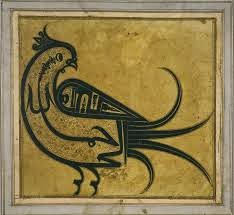
are distinctive and have made a lasting cultural impact across their range. Islamic tradition teaches that the hoopoe
obtained its golden crest from King Solomon for not paying homage to
women. Afterward, so many greedy hunters
sought out and killed hoopoes for their fabulous crests that the hoopoe begged
King Solomon to remove it; he turned their crests into feathers instead. The hoopoe’s relationship with this great
king is further documented in the Quran:
When Solomon was about to punish the bird for being absent from his
court, the hoopoe – known for its habit of eavesdropping – returned hastily,
saying: “I have found out a thing that
thou apprehendest not, and I come unto thee from Sheba with sure tidings.” The hoopoe brought tidings of the woman who
would be Solomon’s queen, and its coming to the king with the news is the
origin of the saying, “A little bird told me . . ."

From the
Punjab of India to Minoan Crete the bird was considered remarkable; it was
thought that the Garudas of Hindu and Buddhist belief were originally
hoopoes. In the Bible, in Leviticus
11:13-19, hoopoes were listed among the animals that are “detestable and should
not be eaten,” and were listed in Deuteronomy as not kosher, possibly due to
their reputation as unusual creatures.
(The hoopoe was chosen the state bird of Israel in 2008!)
Hoopoes
were seen as a symbol of virtue in Persia; a hoopoe was the leader of the birds
in the Persian book of poems The
Conference of the Birds. The hoopoe
is also cast as the king of birds in the ancient Greek comedy The Birds by Aristophanes. One of the most infamous tales involving a
hoopoe is related by Ovid in his Metamorphese,
where, in Book Six, King Tereus of Thrace – married to Procne – rapes his
wife’s sister, Philomela and cuts out her tongue. In revenge, Procne kills their son Itys and
serves him as a stew to his father. When
Tereus sees the boy’s head, which is served on a platter, he grabs a sword but
just as he attempts to kill the sisters, they are turned into birds – Philomela
into a nightingale, Procne into a swallow.
Tereus himself is turned into a hoopoe.
The bird’s showy crest is said to indicate his royal status, and his
long, sharp beak is a symbol of his violent nature.
Hoopoes
were thought of as thieves across much of Europe, especially in that they often
partnered with cuckoos in the raiding of nests; the holes bored by woodpeckers
are a favored nesting place of the hoopoe.
Epithets across their range also distinguish the hoopoe as a “dirty
bird” or a “dung bird,” after the mother hoopoe’s habit of soiling its nest to
discourage incursions by predators – animal and human alike.
This
habit of the female hoopoe gave rise to the old saying, used particularly
against truculent women: “It is an evil
bird that defiles its own nest.”
Medical
practitioners of the ancient world found that many parts of the bird were
marvelously effective in the treatment of a variety of illnesses and
diseases. The Arabs call the hoopoe the
“Doctor because of its medicinal qualities; as a therapeutic the bird appears
in Egyptian, Coptic, and Greco-Roman medical prescriptions, in Pliny, and in
the Syriac Book of Medicine; and as late as 1752, its medicinal virtues were
listed in the English translation of the Pharmacopoeia
Universalis. Even today, nomads of
the Sahara still believe in the bird’s medicinal powers.
Closely
related to the belief is specific medicinal values is the conviction found in
antiquity and still current that the whole, or certain parts of the hoopoe
possess magical powers. These parts are
the heart, the blood, the eyes, the head, the tongue, the wings, and the
feathers. Magical powers are also
claimed for the eggs of the hoopoe and for the fabled stone – the lapis quirinus – found in the hoopoe’s
nest.
It is
said that the heart of the hoopoe is especially used by magicians and people
who “perform evil deeds secretly” – in other words, who practice black
magic. On the other hand, the hoopoe is
often recommended as a protection against witchcraft. Tradition informs us that the hoopoes heart,
when placed upon a sleeper at night, will cause him to reveal hidden things;
the hoopoe’s heart, if carried on a person, will cause everyone to love that
person; drying and pulverizing the heart of a hoopoe, and placing it under the
pillow at night will allow one to dream of the location of hidden treasure.
Concerning
the blood of a female hoopoe, we learn from Albertus Magnus that it, mixed with
the centauria plant and added to the
oil of a burning lamp brings about strange hallucinations. Medieval bestiaries warn against anointing
oneself with the hoopoe’s blood when falling asleep, because then one will
dream of being suffocated by demons. It
is, however, not only unpleasant dreams that the hoopoe’s blood brings, if only
one ties a piece of cloth impregnated with the hoopoe’s blood upon one’s wrist. The wearing of a wig made of the hair of a
hanged man, and moistened with the blood of a hoopoe, makes one invisible. A 15th century German tract states
that the hoopoe’s blood, properly applied, can inspire a man to love a woman;
in Haggadic writings, the blood of the hoopoe is mentioned as a curative.
The eyes
of the hoopoe are a counter-charm against all kinds of witchery, if they are
used in a talisman with feathers that accumulate in the gizzards of owls,
together with a small splinter of wood.
In order to be effective, these three ingredients must be blended in the
last night of the year. The hoopoe’s
eyes are also mentioned as having been carried about in a little sack by
hunters as a talisman against the Devil, evil spirits, witches, and sorcerers,
and as a powerful defense against all manner of black art.
The eyes
of the hoopoe can furthermore make one who carries them on his person
universally loved, accepted. They
inspire cleverness and gratitude; they transform enemies into friends. If carried in a bag they help one to buy
profitably. They assist one in being
acquitted in court if worn on one’s chest in the presence of the judge; at least
they put the judge in a favorable state of mind.
No
merchant can ever deceive you if you carry along in a sack the head of a
hoopoe. The tongue of the hoopoe helps
in overcoming forgetfulness. Accuracy of
shooting is guaranteed through the possession of a charm, composed of the
hearts of three young swallows and the right wing of a hoopoe. The feathers of the hoopoe are one of eight charms that increase the sale of bread
and protect against vermin; when placed
upon the head, the feathers relieve headache.
The eggs of the hoopoe are said to be of interest to witches who use
them “for sorcery. The stone found in
the hoopoe’s nest – the lapis quirinus
– when placed under the head or upon the chest, causes one to reveal secrets
while asleep, and increases fantasies.
In the superstitions
that have to do with the cry or the song of the hoopoe, we find that it
predicts fair weather if its “huppuppup” is heard frequently in spring; on the
other hand, if the bird cries hoarsely it is said to foretell rain. Again, “If the hoopoe do sing before the
vines bud, it foreshadows great plenty of wine”; and, if upon hearing hoopoe’s
call for the first time in the spring of the year, one rolls around on the
ground, one will not suffer lumbago. In
Scandinavia and northern Europe, the same cry (“huphup”) prophesies war and
mourns the dead.
In
Oriental-Semitic traditions, the hoopoe has the faculty of speech and occupies
a special niche among speaking birds, echoing its distinction as King Solomon’s
“little bird.” The same traditions also
describe the hoopoe as a waterfinder, a natural “opener,” and this serves to
strengthen the bird’s title of “Doctor.”
As a waterfinder, the hoopoe is said to be able to see through the earth
and point out hidden springs, a virtue that further endeared it to those living
in desert regions.

The Queen of Sheba and the Little Hoopoe
The power
is, usually, inherent in some magical object (stone, herb, root, worm, etc.)
which the bird owns or which is accessible to it. In the case of the hoopoe, it is said to
possess the famous Shamir, one of the
ten marvels that were created in the twilight of the earth’s first
Sabbath-day. This Shamir is said to be
an exceedingly small worm, in size not larger than a grain of barley, and was
thought to have been used by Moses to engrave the names of the twelve tribes of
Israel on the breastplate of the High Priest.
Later it was employed by Solomon, who obtained it through cunning means,
to assist in the erection of his temple.
According to legend, the great king went to the stone quarries, drew the
outline of every stone that would be needed in the building, and placed the
Shamir worm on these outlines. As the
worm crawled along, the stones split asunder without any noise, “so that there
was neither hammer nor ax, nor any tool or iron heard in the house while it was
building” (I Kings: 6-7).
In
extra-Solomonic “opener” legends, the use to which the hoopoe’s opener is put
is of a much less exalted nature.
Ordinarily, the hoopoe employs the Shamir to burst through obstacles
separating it from its young; it is also said to be placed by the hoopoe in its
nest to “ward off fascination.” If a
man, usually through stealth, obtains possession of the magic object, he abuses
it by gaining through its power treasures that do not belong to him. One of the earliest mentions of the hoopoe’s
possession of the Shamir is found in Aristophanes’ legend of Tereus, Procne,
and Philomela.
In some
legends the hoopoe’s opener is a magic plant – sometimes the centauria, in other texts the cornflower
– that has another distinct virtue, that of restoring to well-being one who has
imbibed too much of the fruit of the vine.
The
Egyptians held the hoopoe in high honor for its devotion to its parents, and
for this reason made it the symbol of gratitude in their hieroglyphs and engraved
it on the scepters of their rulers. One
legend, c. 1100 B.C.E., describes the hoopoe as “plucking the feathers and
licking the eyes of the old birds, and “the young warm them under their wings,
and sit over them until they have grown young once more.” Leonardo da Vinci later confirmed this
ancient observation when he noted in his Bestiary,
“The young [hoopoe] build a nest for the parents, feed them, pluck out old
feathers, and restore eyesight to their parents by licking and by means of an
herb.” Because of this practice, the
hoopoe became associated with the ability to restore youth and impart
immortality on those found worthy.

Among
the English, who knew the hoopoe but little, and then only in temperate seasons
when the birds would follow waves of warmer weather that might encompass the
region, it had the reputation of “feeding upon dirt and dwelling among
graves.” This seems to add weight to
examples of its use in Medieval “nigromancy,”
or necromantic magic.
- A
15th century necromantic manuscript tells how to summon a demon
in the form of a horse by using conjurations, a ring with the
Tetragrammaton inscribed on it, and the blood of a hoopoe.
- Another
manuscript, instructing in the matter of love magic, states: “. . . If you draw it on a Friday with
the feather of a hoopoe and with its blood on a freshly prepared piece of
parchment, and touch a person with it, you will be loved by that person
above all others forever.”
- And,
“There are recipes for madness . . . which involve not imitative magic but
poisons (made from the body parts of a cat, a hoopoe, a bat, a toad, and
other creatures) to be taken in food or drink, or a fume to be inhaled, whereupon
the victim will be bedeviled (demoniabitur),
losing his senses and memory, and not even knowing who he is.”
- And
also, “The markings on this cloth are to be made with the blood of . . . a
hoopoe, [and] the magician is meant to use the heart of this bird as a
writing instrument.”
In the Americas, there is
only one known instance of a hoopoe having been sighted. In 1978, in Alaska, a lone European hoopoe
was seen by birders feeding among natural debris that had collected in the
waters of a thawing creek. The sighting
was duly noted with the annotation, “Possibly significant that the bird is
feeding at Old Chevak shaman’s garden.”
No doubt
the magical little hoopoe knew exactly why he was feeding there; but maybe this
is something he will never tell.

NOTE: The information provided in this article is collected from folklore, and
is presented as INFORMATION ONLY. Animal abuse is punishable by law.
The Author and Publisher are not responsible for the intentional misuse of the
information provided herein.
All material Copyright (c) 2011-2015 by Alyne Pustanio and Creole Moon Publications.
Reproduction or dissemination of this article in any form without the expressed written
consent of the Author and/or Publisher is strictly prohibited by law.


